

Sign up for Executive Dysfunction, a newsletter that highlights one under-the-radar story each week about how Trump is changing the law—or how the law is pushing back. You’ll also receive updates on the latest from Slate’s Jurisprudence team.
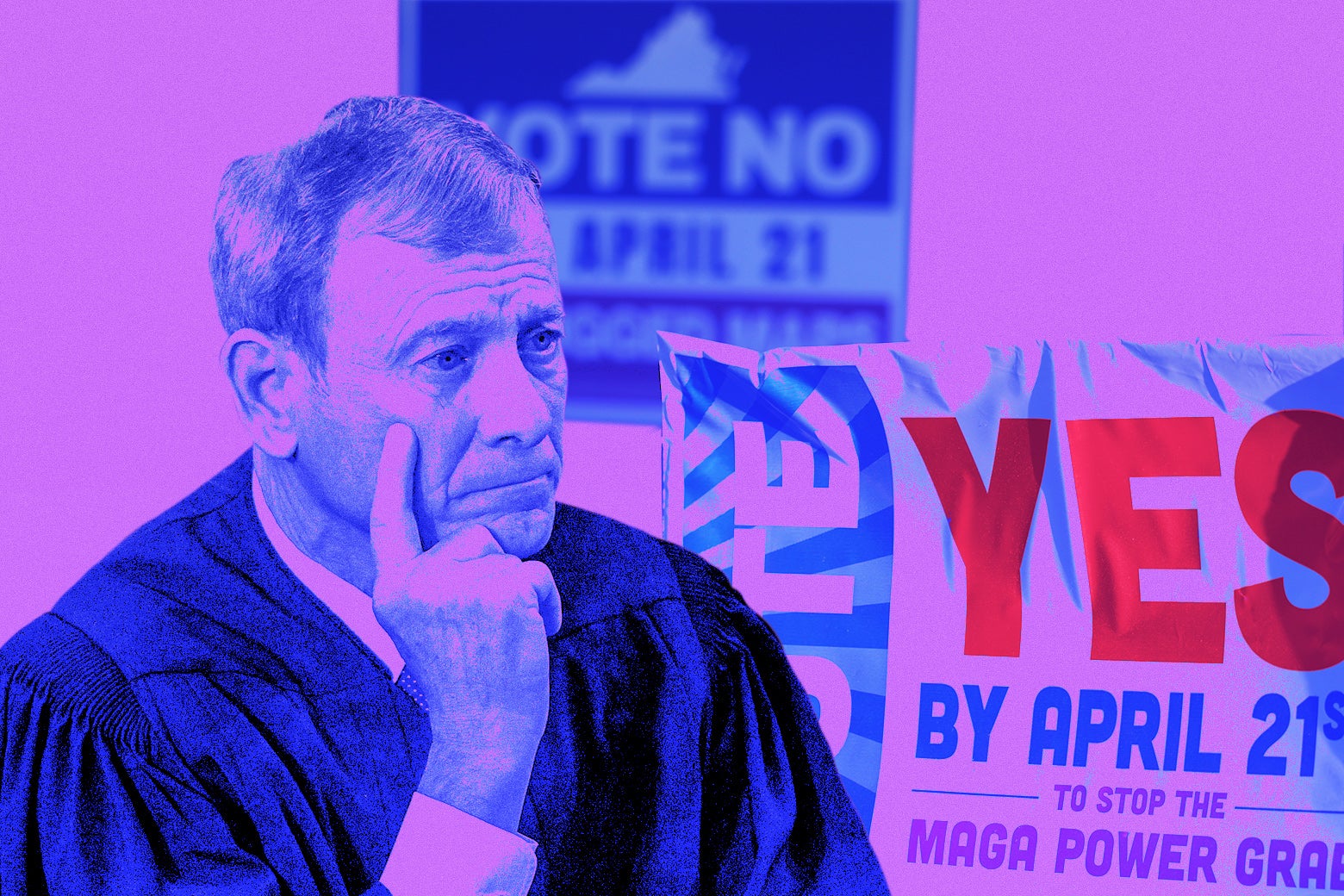
Virginia voters delivered a major blow to Republicans on Tuesday by approving a constitutional amendment that will give Democrats up to four additional seats in the House of Representatives. Democratic lawmakers in the commonwealth proposed the new map to level the playing field after President Donald Trump pressed red states like Texas to enact fresh partisan gerrymanders in advance of the 2026 midterms. Virginia previously used a nonpartisan committee to draw its congressional districts, but voters decided to fight fire with fire by adopting the new map, with its 10–1 Democratic advantage. The result will more than offset the GOP’s gains from this year’s unprecedented mid-decade red-state gerrymanders and further diminish its chances of holding on to the House.
On this week’s Slate Plus bonus episode of Amicus, co-hosts Dahlia Lithwick and Mark Joseph Stern discussed Tuesday’s vote with Madiba Dennie, deputy editor of Balls and Strikes and author of The Originalism Trap. They explored the Supreme Court’s role in the current redistricting wars, the virtues of constitutional hardball, and the still-unresolved legal fate of Virginia’s amendment. A preview of their conversation, below, has been edited and condensed for clarity.
Dahlia Lithwick: There was a lot of Republican bellyaching this week over these results. But didn’t the Supreme Court pretty much roll out the red carpet for this kind of electoral hardball with the decision in Rucho v. Common Cause?
Madiba Dennie: It really did. This is a great example of playing gerrymandering games and winning gerrymandering prizes. In Rucho, the Supreme Court said it didn’t think the Founding Fathers really intended federal courts to police gerrymandering. It claimed there were no real standards to measure gerrymanders, so this was more of a political question. And if citizens found themselves in a situation where representatives were picking voters instead of voters picking representatives, maybe they should go vote about it, because there’s nothing that federal courts can do. Of course, the whole point of this case was that people couldn’t vote their way out of gerrymanders! So this was really an exercise in weaponized incompetence. By that point, courts had been ruling against partisan gerrymanders for a while. But suddenly the Supreme Court said: Actually, there’s nothing we can do about it.
Mark Joseph Stern: It’s important to remember that Rucho was decided in 2019, when Republicans were deeply invested in the gerrymandering game, and Democrats were trying to get out of that game. Blue states like California had implemented independent redistricting commissions that drew fair maps. Twenty-two Democratic attorneys general urged the Supreme Court to rein in partisan gerrymandering. Ten Republican attorneys general asked the Supreme Court not to put constitutional limits on partisan gerrymandering. Rucho was a 5–4 decision, with Chief Justice John Roberts writing for the conservatives, and I suspect he thought this would disproportionately help Republicans over Democrats. I doubt he expected states like Virginia to play hardball. But this is exactly what Roberts said he wanted: Let the states decide!
Lithwick: This entire week has been a referendum on the profound limitations of “When they go low, you go high,” right? Sometimes, you go the same amount of low, and you win for a change. This is hardball prevailing, and we’re just not used to hardball prevailing for anyone but Sam Alito.
Dennie: It’s funny, because Republicans could have come together with Democrats at any time and said: We’re going to end partisan gerrymandering, we’ll have fair maps and let the voters decide. But Republicans said, No, we don’t want that. We want to rig ourselves a structural advantage. And now that Democratic voters decided they wanted a little structural advantage too, Republicans scream and cry.
Stern: We should also point out that Democrats in Congress proposed a national ban on partisan gerrymandering in 2021! Which Republicans unanimously rejected. They didn’t even come to the table to try to bargain for some compromise. We could have avoided the current redistricting wars if Democrats had gotten their way, but Republicans decided they shouldn’t, and that led directly to this Virginia vote.
Lithwick: That takes us to Republicans’ freshly baked legal challenge to the Virginia measure. What’s the basis for the allegation that a constitutional amendment somehow violates the state constitution?
Stern: The Republican challengers have thrown a bunch of different claims at the wall. But the only argument with even a plausible chance of prevailing, in my view, is that the General Assembly—Virginia’s Legislature—didn’t follow the proper procedure. The Virginia Constitution requires the General Assembly to pass a constitutional amendment twice before it goes to the voters, and the first vote must occur before the “next general election” of the House of Delegates. Here, the Assembly first approved the amendment on Oct. 31, 2025. The general election was held on Nov. 4, just a few days later. Then the new Assembly was seated in January 2026, and it approved the amendment again.
The former Republican attorney general of Virginia, Jason Miyares, wrote official guidance in 2025 claiming that this process would be unconstitutional. He claimed that, because people were early-voting when the Assembly first approved the amendment, the election was already occurring. So the “next general election” wouldn’t be until 2027, and the Assembly would need to re-approve the amendment in 2028. But Miyares was then ousted by a Democrat, Jay Jones. And Jones’ first act in office was to overturn that opinion and declare that the Assembly was following a lawful process. His reasoning is pretty airtight: The Virginia Constitution says exactly when the “general election” was held for legal purposes, and it was Nov. 4, 2025. Early voting is irrelevant to the constitutionally required date of the “election” itself. And the Assembly first approved the measure before that date. So it followed the legal process required to send an amendment to the voters.
Lithwick: So why has a judge already blocked it?
Stern: Because Republicans shopped their lawsuit to a GOP judge. He already tried to block the amendment from going to the voters, but the Virginia Supreme Court overruled him. Now he has blocked it from being certified, but the Virginia Supreme Court will have the last word, and is holding a hearing next week. I think it’s very unlikely that the court will rule against the amendment. It already allowed the election to move forward, which is a pretty strong tell that it’ll uphold the result. And while the court leans center-right, it isn’t crazy. The justices are appointed by the Assembly, and are traditionally quite deferential to it. So I highly doubt they will decide that this democratically enacted amendment violates the very constitution it is amending.
Source link
